



October Seminar Series
October 22, 2025
We were thrilled to welcome Dr Abhi Pratap - Global Clinical Development Lead at Boehringer Ingelheim who delivered our October Seminar Series. In his talk “Why Mental Health Needs More Than New Drugs: Using Digital Health to Bring Patient-Centredness to Research and Care", Abhi shared case examples from emerging clinical studies to show how digital health can bridge the gap between clinical research and patient care in mental health. We will explore digital health solutions that help quantify the real-world experiences of health that matter to people - bringing us closer to understanding what treatments work for whom, why, when, and for how long.
Abstract:
Innovation in mental health treatment has been strikingly limited compared to other fields of medicine. In the last 15 years, fewer than five truly novel psychiatric drugs have received regulatory approval. This stagnation reflects multifaceted challenges linked to heterogeneity of psychiatric disorders often lacking biological markers grounded in disease biology. Additionally, there is significant reliance on subjective clinician-, rater-, or patient-reported outcomes, which increases variability in trial outcomes and poses challenges in patient selection and endpoint determination. Clinical studies also encounter persistent obstacles, such as high dropout rates, poor generalizability, and endpoints that frequently do not reflect what patients and their families value most. Consequently, there is a critical gap in new treatment development that are patient-centered, enhancing quality of life in real-world settings.
Use-case-centered implementation of digital health technologies offers a realistic path to address many of these barriers. Real-world data collected from smart devices can enable the continuous and ecologically valid capture of mood, cognition, behavior, and functioning, augmenting traditional, episodic assessments. This richer measurement framework can enhance sensitivity to change, reduce trial inefficiencies, and ground outcomes more directly in patients lived experience. In addition, the same smart devices can be used to deliver digital adaptations of psychosocial interventions, expanding access to evidence-based care and offering personalized and scalable options for populations that have been historically underserved due to stigma, geography, or cost.
Dr. Abhi Pratap is the Global Clinical Development Lead at Boehringer Ingelheim, where he oversees clinical development programs for digital therapeutics aimed at addressing unmet needs in serious mental illnesses. Before joining Boehringer, he worked at Biogen, managing one of the largest decentralised studies on cognitive trajectories in real-world settings in collaboration with Apple.
With over 15 years of experience in translational biomedical research, Dr. Pratap has led numerous health research studies that promote partnerships between academia and industry. His primary focus is on using digital health technologies to gain a deeper understanding of the real-life experiences of individuals with neurological and psychiatric disorders. His cross-sector research aims to accelerate patient-centered clinical development in central nervous system (CNS) disorders. Most recently, he led a successful pivotal Phase III trial targeting experiential negative symptoms of schizophrenia (NCT05838625) using a digital therapeutic. This study is among the first confirmatory trials to show improvement in negative symptoms to date.
Additionally, Dr. Pratap serves as an adjunct faculty member at the University of Washington in Seattle and Boston University, and he is a visiting research fellow at King’s College London.
Share
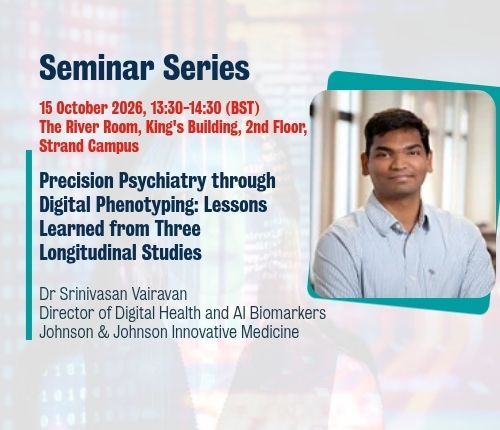
We are delighted to welcome Srinivasan Vairavan , Director of Digital Health and AI Biomarkers at Johnson & Johnson Innovative Medicine R&D and Visiting Lecturer at King's College London , to deliver his seminar, "Precision Psychiatry through Digital Phenotyping: Lessons Learned from Three Longitudinal Studies in major depressive disorder" , as part of the EPSRC DRIVE-Health Seminar Series. Abstract: Major Depressive Disorder (MDD) remains diagnosed and monitored almost entirely through episodic, subjective self-report, limiting both clinical care and trial sensitivity. This lecture presents evidence that passively collected digital signals can objectively characterize core MDD symptom domains and track an individual's mental state continuously between clinic visits. Drawing on more than 1,000 patients across three major longitudinal cohorts — RADAR-CNS, ORBIT (NCT02489305), and CANBIND — we describe methods that translate subtle behavioral and physiological data into clinically interpretable biomarkers. Paralinguistic analysis of speech is used to quantify psychomotor retardation, while fractal signatures derived from actigraphy index depression severity and impending relapse. Building on these markers, we present a personalized, N-of-1 anomaly detection framework that fuses passive digital streams with intermittent self-report to flag elevated relapse risk at the individual level. Results support the clinical validity of this approach. Digital measures, including speech intensity, showed significant associations with clinical outcomes. The relapse prediction model achieved a balanced accuracy exceeding 71%, with a median detection lead time of two to three weeks prior to clinical onset and a low false alarm rate — a profile compatible with real-world deployment. The lecture will also address principal sources of measurement variability, including seasonal effects, and the emerging relationship between cognitive performance and digital biomarkers. Together, these findings indicate a shift from episodic subjective assessment toward objective, unobtrusive, and continuous monitoring in mental healthcare — with near-term implications for patient selection and endpoint sensitivity in clinical trials, and longer-term potential for personalized diagnosis and treatment in MDD. Seminar Series Event : "Precision Psychiatry through Digital Phenotyping: Lessons Learned from Three Longitudinal Studies in major depressive disorder" Date and Time: Thursday 15 October 2026, 13:30 – 14:30 (BST) Location: The River Room, King’s Building, 2nd Floor, Room KIN 227, Strand Campus Attendance: Mandatory for all DRIVE-Health students; a calendar invitation has already been sent. Registration: Alumni and the wider King's College London research community are welcome - no booking required. Biography Srinivasan Vairavan , PhD, is Director of Digital Health and AI Biomarkers within Neuroscience Data Science and Digital Health at Johnson & Johnson Innovative Medicine R&D, and a Visiting Lecturer in the Department of Biostatistics and Health Informatics at the Institute of Psychiatry, Psychology and Neuroscience, King's College London. He has over 15 years of experience building and scaling AI, machine learning and advanced analytics capabilities across pharma and healthcare, with prior roles at Proteus Digital Health and Philips Research. His work translates large-scale clinical, digital health, molecular and EHR data into regulatory-grade endpoints, including engagement through FDA Type C meetings and EMA Qualification Advice, and co-development of the industry-wide V3+ framework. He leads and contributes to major international consortia including RADAR-CNS, RADAR-AD and AMP-SCZ. He holds patents in relapse prediction in major depressive disorder and speech-based detection of cognitive decline, sits on the editorial board of BMC Digital Health, and serves on the DRIVE-Health advisory board.

We are looking forward to welcoming Professor Honghan Wu, Professor of Health Informatics and AI at the University of Glasgow, who will deliver his talk “Large language model and Radiology: how to facilitate human and AI collaboration? " as part of our Seminar Series. Abstract: In this upcoming talk, Professor Honghan Wu explores the essential shift from viewing AI as a potential replacement for radiologists to recognizing it as a critical collaborative partner. Moving beyond basic tasks like detection and triage, the presentation highlights how AI can address practical clinical "pain points," such as reducing automated protocoling time by up to 60% and decreasing the time spent communicating with providers and patients by 30%. Professor Wu will present recent research on using knowledge-retrieval and Large Language Models for clinical report error correction and generation. The session concludes with an examination of the real-world deployment lifecycle, discussing the challenges of monitoring the over 700 FDA-cleared radiology AI devices currently in practice Seminar Series Event : “Large language model and Radiology: how to facilitate human and AI collaboration?" Date and Time: Thursday 25 November 2026, 15:00 – 16.00 hrs (GMT) Location: Venue to be confirmed. Attendance: Mandatory for all DRIVE-Health students; a calendar invitation has already been sent. Registration: Alumni and wider King's College London research community all welcome - please email drive-health-cdt@kcl.ac.uk to let us know if you would like to attend. Biography Honghan Wu is a Professor of Health Informatics and AI, based in the School of Health and Wellbeing of the University of Glasgow, where he leads the research theme of data science and AI. Prof Wu is a co-director of Health Data Research Scotland. He also is an honorary professor at Hong Kong University, an honorary associate professor at Institute of Health Informatics, UCL, and a former Turing Fellow of The Alan Turing Institute, UK's national institute for data science and artificial intelligence. Prof Wu holds a PhD in Computing Science. His current research focuses on machine learning, natural language processing, knowledge graph and their applications in medicine.